Relocation Guide · August 18, 2026 · by Erin Ward, Owner, Real Estate Coach
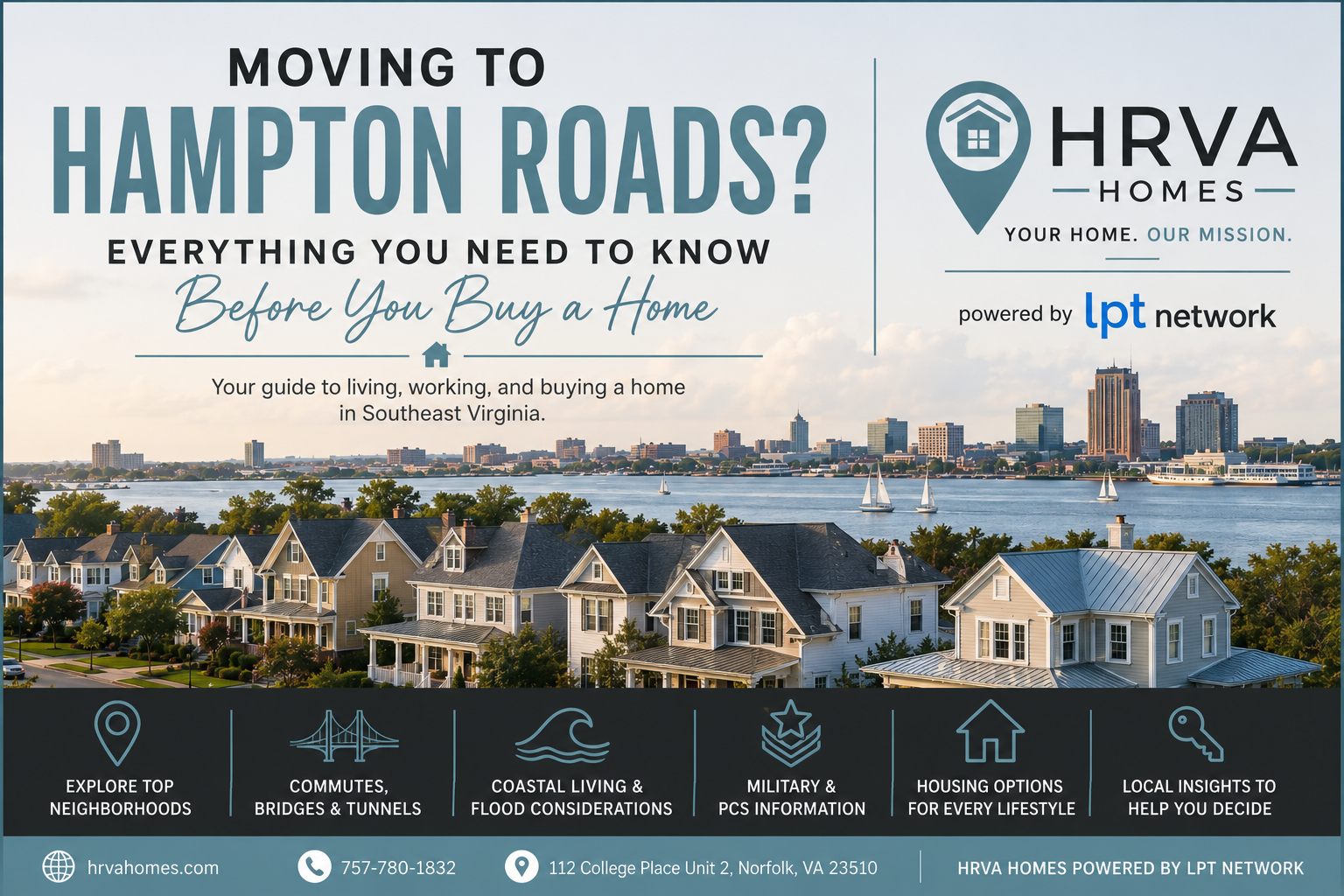
Moving to Hampton Roads, VA? 2026 Home Buying Guide
In short: Hampton Roads is a coastal region in southeastern Virginia that includes Norfolk, Virginia Beach, Chesapeake, Suffolk, Portsmouth, Hampton, and Newport News, with nearby communities including Poquoson, York County, and Williamsburg. Home buyers should consider commute routes, bridges and tunnels, flood risk, proximity to military installations and major employers, housing style, and lifestyle preferences before choosing where to live.
If you're moving to Hampton Roads, one of the first things you'll discover is that choosing where to live can be just as important as choosing the home itself.
Hampton Roads isn't one city. It's a collection of cities and communities spread across southeastern Virginia, separated in places by rivers, harbors, and the Chesapeake Bay.
You can live near the Atlantic Ocean in Virginia Beach, walk to restaurants from a historic Norfolk neighborhood, find more suburban development in Chesapeake, explore larger lots in parts of Suffolk, or live across the water on the Peninsula in Hampton, Newport News, York County, or nearby Williamsburg.
That variety is one of the things we love about living here, but it also means your home search deserves a local strategy.
Here's what to know before you buy.
Where Is Hampton Roads, Virginia?
Hampton Roads is located in southeastern Virginia, where the Chesapeake Bay meets the Atlantic Ocean.
The region generally includes:
Norfolk
Virginia Beach
Chesapeake
Suffolk
Portsmouth
Hampton
Newport News
Depending on the context, the greater Hampton Roads area also includes communities such as Poquoson, York County and Williamsburg.
You'll frequently hear locals describe the region as two areas: the Southside and the Peninsula.
The Southside includes cities such as Norfolk, Virginia Beach, Chesapeake, Portsmouth and Suffolk.
The Peninsula includes Hampton and Newport News, extending north into York County and Williamsburg.
The water separating these areas makes Hampton Roads beautiful. It also makes understanding your commute particularly important.
What Is It Like Living in Hampton Roads?
One of the biggest advantages of Hampton Roads is variety.
Within the same region, you'll find oceanfront communities, historic neighborhoods, urban condos, established suburbs, newer construction, waterfront homes and properties with larger lots.
The region also has a strong connection to the water. The Atlantic Ocean, Chesapeake Bay, Elizabeth River, James River and countless smaller waterways influence everything from recreation to transportation and real estate.
You can spend a Saturday at the Virginia Beach Oceanfront, catch a baseball game in downtown Norfolk, explore historic Williamsburg, kayak from a neighborhood launch, or find a waterfront restaurant for dinner.
For someone relocating here, that variety makes it important to decide what matters most before narrowing your home search.
Which Hampton Roads City Should I Live In?
There isn't one correct answer. Each city offers different housing, amenities, commute considerations and surroundings.
Norfolk
Norfolk combines historic neighborhoods, waterfront communities, urban living and established residential areas.
Buyers can explore everything from historic homes in Ghent to coastal communities around Ocean View and East Beach, along with neighborhoods throughout the city.
Norfolk is also home to Naval Station Norfolk and has convenient access to Downtown Norfolk, Old Dominion University and Eastern Virginia Medical School.
If you're considering Norfolk, start with our 5 Most-Searched Neighborhoods in Norfolk, VA and our Ghent Neighborhood Guide.
Virginia Beach
Virginia Beach is geographically large, so living in Virginia Beach can mean very different things depending on the part of the city you choose.
Housing ranges from oceanfront and Chesapeake Bay properties to established suburban neighborhoods, townhomes, condos and newer communities farther inland.
Virginia Beach is also home to NAS Oceana, Dam Neck Annex and portions of Joint Expeditionary Base Little Creek-Fort Story.
Read our Living in Virginia Beach: What to Know Before You Buy Near the Coast guide for a closer look.
Chesapeake
Chesapeake offers a mix of established neighborhoods, newer developments, townhomes, condos and properties with more land in certain sections of the city.
Because Chesapeake covers a large geographic area, commute times can vary considerably depending on where you live and work.
Someone commuting to Norfolk may approach the search differently from someone working in Virginia Beach or elsewhere in Chesapeake.
Suffolk
Suffolk is another geographically large Hampton Roads city.
Buyers can find newer developments, established neighborhoods, historic areas, waterfront properties and homes with larger lots.
For people who want additional space, Suffolk may deserve a closer look, but commute routes should be evaluated carefully before choosing a specific area.
Portsmouth
Portsmouth sits directly across the Elizabeth River from Norfolk and includes historic districts, established neighborhoods and waterfront areas.
Buyers commuting between Portsmouth and Norfolk should become familiar with the Downtown and Midtown tunnels and applicable tolls.
Hampton
Hampton sits on the Peninsula and provides access to communities along the Chesapeake Bay and Hampton Roads harbor.
Its location can work particularly well for people whose daily lives are centered on the Peninsula.
Newport News
Newport News stretches along the James River and includes a wide range of residential areas.
Major employment centers in and around Newport News include shipbuilding, military installations, health care, education and other industries.
York County, Poquoson and Williamsburg
Buyers who broaden their search beyond the seven core Hampton Roads cities may also consider York County, Poquoson and Williamsburg.
These areas can make sense for buyers working on the Peninsula or people who prefer their particular housing options, community layout or proximity to the Historic Triangle.
What Should I Know About Hampton Roads Traffic and Tunnels?
This may be one of the most useful pieces of local advice we can give someone moving here:
Look at the commute before you fall in love with the house.
Waterways create natural transportation bottlenecks throughout Hampton Roads.
Major crossings include:
Hampton Roads Bridge-Tunnel on I-64
Monitor-Merrimac Memorial Bridge-Tunnel on I-664
Downtown Tunnel
Midtown Tunnel
High Rise Bridge
James River Bridge
George P. Coleman Memorial Bridge
Traffic conditions can vary significantly based on time of day, construction, accidents and bridge or tunnel conditions.
The Hampton Roads Bridge-Tunnel is also undergoing a major expansion. As of 2026, the $3.9 billion project is adding twin two-lane bored tunnels and widening sections of the nearly 10-mile I-64 corridor between Hampton and Norfolk.
Before choosing a neighborhood, check the commute during the hours you'll actually be traveling. A location that looks close on a map can feel very different during weekday traffic.
Should Flood Zones Matter When Buying a Home in Hampton Roads?
Yes. Hampton Roads is a coastal region, so flood risk should be part of your research when considering a property.
Flood risk can vary from one neighborhood to another and even from one property to another.
Before purchasing, buyers should consider:
The property's FEMA flood designation
Whether the lender requires flood insurance
Available flood insurance options and cost
Property elevation
Previous flooding or water intrusion information
Drainage around the property
Proximity to tidal waterways
A home being near the water doesn't automatically tell you its flood risk, and a home away from obvious waterfront may still be located within an area with flood considerations.
Review the specific property rather than making assumptions based solely on the neighborhood.
Is Hampton Roads a Good Area for Military Home Buyers?
Military life is a major part of Hampton Roads.
The region contains numerous military installations and supports a large active-duty, veteran, civilian and military-family population. Naval Station Norfolk is the world's largest naval installation based on support population, and Hampton Roads has installations representing multiple branches of the U.S. military.
Major installations in and around Hampton Roads include:
Naval Station Norfolk
Naval Air Station Oceana
Joint Expeditionary Base Little Creek-Fort Story
Dam Neck Annex
Joint Base Langley-Eustis
Naval Weapons Station Yorktown
Naval Medical Center Portsmouth
Naval Support Activity Hampton Roads
Because installations are spread throughout the region, your duty station can have a major impact on where you decide to live.
A home that makes sense for someone stationed at NAS Oceana may create a very different commute for someone assigned to Joint Base Langley-Eustis.
If you're PCSing here, read our PCSing to Hampton Roads: A Military Family's Home-Buying Timeline before starting your search.
Can I Use a VA Loan to Buy a Home in Hampton Roads?
Eligible service members, veterans and certain surviving spouses may be able to purchase a home using a VA-backed mortgage.
VA loans can provide benefits such as no required down payment in many situations and no private mortgage insurance requirement.
The exact costs, eligibility requirements and loan terms depend on your individual situation.
For military buyers moving to Hampton Roads, speaking with a lender experienced with VA financing early in the process can help you establish a realistic budget before you begin touring homes.
What Types of Homes Can You Find in Hampton Roads?
Hampton Roads doesn't have one dominant housing style.
Depending on where you search, you may encounter:
Historic homes
Traditional single-family homes
Brick ranches
Coastal cottages
Townhomes
Condominiums
New construction
Waterfront properties
Homes with larger lots
Urban lofts and condos
Age can vary significantly as well.
Some Norfolk neighborhoods contain homes that are more than a century old, while growing areas of Chesapeake, Suffolk and other communities offer much newer construction.
That makes inspection strategy important. The questions you ask about a 1920s historic home may be very different from the questions you ask about a recently built property.
Should I Rent or Buy When Moving to Hampton Roads?
That depends on your finances, expected length of stay, housing needs and long-term plans.
Buying may make sense if you're financially prepared, plan to remain in the area long enough for ownership to fit your goals, and find a property that works within your budget.
Renting may provide additional flexibility if you're unfamiliar with the region, expect a shorter stay or aren't ready for the responsibilities of homeownership.
For military families, PCS timelines add another consideration. Think about what would happen to the property if you received orders earlier than expected.
Would you sell it? Keep it as a rental? Would either option fit your finances?
Those questions are worth discussing before purchasing.
How Early Should I Start Looking for a Home Before Moving to Hampton Roads?
Starting early gives you time to learn the region before making a decision.
You don't necessarily need to begin touring homes months before your move, but you can start researching communities, financing and commute options well in advance.
A good early relocation plan includes:
Determine where you'll work or report for duty.
Establish your home-buying budget.
Get pre-approved when the timing is appropriate.
Identify your acceptable commute.
Compare several Hampton Roads cities or communities.
Decide which home features matter most.
Begin monitoring homes in your target areas.
Tour homes in person or virtually when you're ready to purchase.
For the complete buying process, read our Ultimate Guide to Buying a Home in Hampton Roads (2026).
Can You Buy a Hampton Roads Home From Out of State?
Yes.
Many Hampton Roads buyers begin their home search while living somewhere else, especially military families receiving PCS orders.
Virtual showings, video walkthroughs, electronic documents and remote communication make it possible to complete much of the process from another state or country.
If you're buying remotely, your local real estate agent becomes especially important. You need someone who can show you more than the best camera angles.
Ask about the street, surrounding properties, traffic noise, property condition, commute and anything else that might be difficult to evaluate from a listing online.
What Are Common Mistakes People Make When Moving to Hampton Roads?
One of the biggest is choosing a home before fully researching the location.
A few issues deserve extra attention:
Ignoring the commute. Crossing a bridge or tunnel every day can significantly change your experience.
Assuming all parts of one city are similar. Virginia Beach, Chesapeake, Suffolk and other Hampton Roads cities cover large areas.
Skipping flood research. Evaluate the individual property's flood information and potential insurance costs.
Focusing only on the home's purchase price. Consider taxes, insurance, potential HOA or condo fees, commuting expenses, maintenance and other ownership costs.
Choosing based solely on online recommendations. Neighborhood preferences are personal. Research objective information, visit areas when possible and decide which location fits your priorities.
How Do I Choose the Right Area of Hampton Roads?
Start with your daily life rather than a list of supposedly "best" neighborhoods.
Ask yourself:
Where will I work?
How much time am I comfortable commuting?
Do I want to be near the beach or water?
Do I prefer an urban, suburban, historic or more spread-out setting?
What type of home do I want?
What is my total monthly housing budget?
Are there specific amenities I want nearby?
How important is access to interstates?
Would crossing a bridge or tunnel be part of my daily routine?
Those answers will usually narrow a very large region into a much more manageable home search.
Ready to Move to Hampton Roads?
Moving to a new area comes with a lot of questions, especially when that area includes several cities, military installations, beaches, rivers, bridges, tunnels and hundreds of neighborhoods.
That's where local knowledge makes a difference.
At HRVA Homes powered by LPT Network, we help buyers understand the bigger picture before choosing a property. Whether you're PCSing to Hampton Roads, relocating for work, moving across Virginia or already living here and ready for your next home, our team can help you compare your options and build a home search around what matters to you.
Your Home. Our Mission.
Ready to start exploring Hampton Roads? Connect with HRVA Homes to start your home search.
Frequently asked questions
The core Hampton Roads region generally includes Norfolk, Virginia Beach, Chesapeake, Suffolk, Portsmouth, Hampton and Newport News. The broader metropolitan region also includes additional nearby communities such as Poquoson, York County and Williamsburg.
Neither city is universally better. Norfolk and Virginia Beach offer different housing options, locations, commute patterns and amenities. The better choice depends on your budget, workplace, preferred housing style and lifestyle priorities.
Some properties may require flood insurance based on flood risk and lender requirements. Buyers should research the individual property's flood designation and insurance options before purchasing.
Hampton Roads has one of the country's largest military communities, with numerous installations and a significant population of active-duty service members, veterans, military families and Department of Defense employees.
No. Hampton Roads is a region made up of multiple independent cities and surrounding communities in southeastern Virginia.
Yes. Many Hampton Roads residents commute between cities. Your actual commute will depend heavily on the specific locations of your home and workplace, the route you use and traffic conditions.
Start with your workplace or duty station, realistic housing budget and acceptable commute. From there, compare communities that meet those requirements before focusing on individual homes.
Have a Hampton Roads real estate question?
Our team answers questions like these every day. Reach out and we'll give you a straight answer.