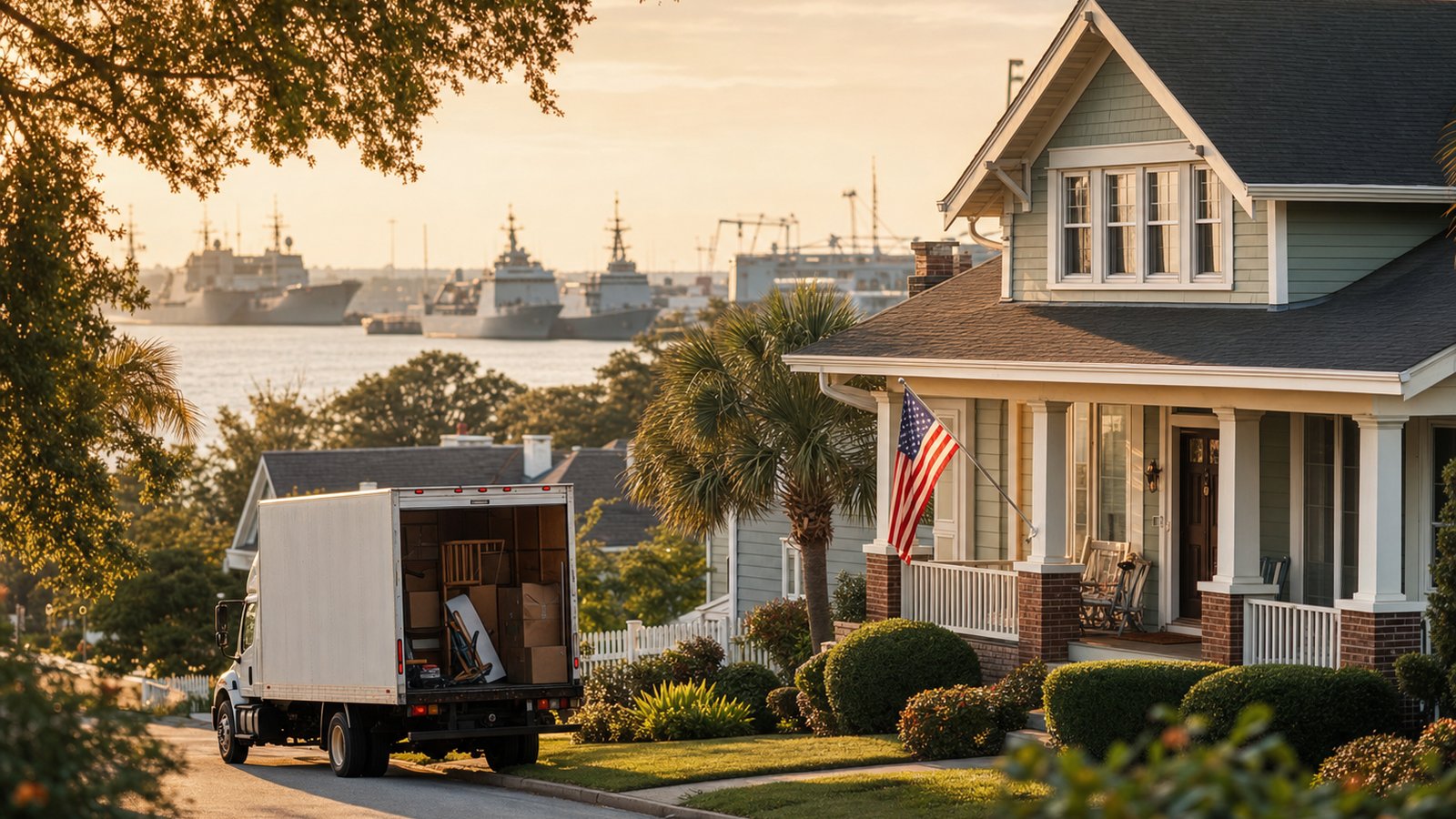
New to Hampton Roads? Start here.
Neighborhoods, cost of living, schools, and everyday life across Norfolk, Virginia Beach, Chesapeake, and the rest of Hampton Roads — plus a dedicated section for military families on PCS orders.
Hampton Roads at a glance
~1.8M
Metro population across 7 core cities
5–10%
Below the national cost-of-living average
No
State income tax on Social Security
7+
Military installations across the region
Figures are general regional estimates based on published 2026 cost-of-living indexes (costoflivingbystate.com) and should be treated as a starting point, not a quote — ask us for numbers specific to your budget.
A quick tour of the seven cities
Hampton Roads isn't one city — it's seven, each with its own personality, price point, and commute pattern. Here's the short version.
Norfolk
Historic, walkable neighborhoods like Ghent and Larchmont, the shortest commute to Naval Station Norfolk, and the region's most affordable median home prices.
Virginia Beach
The oceanfront, top-rated schools, and the region's largest population — commands a premium but offers the most resort-style lifestyle.
Chesapeake
Newer construction, more square footage per dollar, and strong schools — popular with families who want space and a shorter build timeline.
Hampton
The region's most affordable median price, close to Joint Base Langley-Eustis, with a quieter, small-city feel and easy access to the Peninsula.
Newport News
Home to Newport News Shipbuilding, with a mix of established neighborhoods and waterfront pockets along the James River.
Suffolk & Portsmouth
Suffolk offers small-town character with room to grow; Portsmouth has some of the region's best-value historic housing stock along the Elizabeth River.
Schools, commute, and things to do
Schools
Virginia Beach City Public Schools and Chesapeake Public Schools consistently rank among the region's strongest, with well-regarded pockets in Norfolk and Suffolk too. Ask us to pull ratings and zoning for any specific address.
Getting around
Hampton Roads is split by water, so bridge-tunnels (HRBT, MMBT, MLK) drive commute times more than raw mileage. We factor tunnel traffic into every neighborhood recommendation.
Weekends
Oceanfront beaches, the Chesapeake Bay, Colonial Williamsburg less than an hour away, a growing craft brewery scene, and year-round festivals across every city.
PCSing to Hampton Roads
Hampton Roads is home to Naval Station Norfolk (the world's largest naval base), JEB Little Creek–Fort Story, NAS Oceana, Joint Base Langley-Eustis, and more. Nearly every installation falls under one of two Military Housing Areas (MHAs), which set your BAH regardless of which city you actually choose to live in.
Norfolk/Portsmouth MHA (VA298)
Covers Norfolk, Virginia Beach, Chesapeake, Portsmouth, and Suffolk — home to Naval Station Norfolk, Little Creek, and Oceana.
Hampton/Newport News MHA (VA297)
Covers Hampton and Newport News — home to Joint Base Langley-Eustis and Newport News Shipbuilding.
2026 BAH snapshot (with dependents)
E-5: ~$2,430–$2,274/mo · E-7: ~$2,604–$2,439/mo, depending on MHA. Always confirm your exact rate at the DoD BAH calculator.
Let's find your Hampton Roads home
Whether you're relocating for work, retiring to the coast, or PCSing with orders in hand, we'll walk you through the neighborhoods that fit your budget and your life.
Get my custom relocation plan